

Accelerate Your Drug Development With Tebubio's Flexible LNP Formulation Solutions
Tebubio helps researchers and biotech innovators turn promising molecules into therapeutic realities.
Our lipid nanoparticle (LNP) formulation and encapsulation services are designed to support a wide range of payloads, offering precision, reproducibility, and performance without requiring in-house formulation expertise.

Xavier Warnet, PhD, Project Manager performing encapsulation of mRNA inside LNP
Our LNP Formulation and Encapsulation Offer
- Choice of ionisable lipids
- Choice of conjugated lipids (fluorescent; peptide)
- Formulation parameters (N/P ratio; FRR; TFR)
- Your molecule (mRNA, siRNA, saRNA, DNA, oligonucleotide)
- From 10 µg to 5 mg
- DLS: particle size and polydispersity
- Quantification: encapsulation efficiency, RNA concentration and payload integrity
- Zeta potential
- Endotoxin measurement
- Transfection efficiency
- 2D or 3D culture, multiple cell lines available
- Translation efficiency
- Cell-based assay (cytotoxicity…)
- Choice of ionisable lipids
- Choice of conjugated lipids (fluorescent; peptide)
- Formulation parameters (N/P ratio; FRR; TFR)
- Your molecule (mRNA, siRNA, saRNA, DNA, oligonucleotide)
- From 10 µg to 5 mg
- DLS: particle size and polydispersity
- Quantification: encapsulation efficiency and payload integrity
- Zeta potential
- Endotoxin measurement
- Transfection efficiency
- 2D or 3D culture, multiple cell lines available
- Translation efficiency
- Cell-based assay (cytotoxicity…)
Formulation Optimization
Our experts design a bespoke LNP formulation, carefully selecting lipid components, ratios, and encapsulation techniques to achieve the highest efficiency, stability, and biological performance.
Tebubio offers a wide range of lipids: ionizable lipids with specific tropisms (brain, lung, spleen, etc), different sterols, a large catalogue of PEGylated lipids as well as lipids conjugated to fluorescent probes (for tracking) or peptides (for active targeting and/or improved transfection efficiency). We can use pre-mixed kits, mimicking validated formulations used in COVID vaccines for example, or prepare a custom blend.
From your lipid mix, we then perform encapsulation optimization of your payload using microfluidics systems. This allows us to precisely control the formulation parameters (N/P ratios, Flow rate ratios (FRR) or Total flow rate (TFR)), hence enabling us to find the sweet spot to get particles with the best biophysical characteristics.
You benefit from advanced formulation know-how, without the need for internal development or capital equipment investment.

Figure 1 - Evaluation of the encapsulation efficiency and in vitro transfection of LNP-mRNA in HCT116 cells using formulations with different ionizable lipids.
Encapsulation Offer
At Tebubio CRO, we have extensive experience in the encapsulation of different nucleic acids molecules: mRNA, saRNA, ASO, siRNA, or DNA. We have built from these experiences and propose flexible encapsulation offers.
Looking for small-scale validation of your model?
We can encapsulate as little as 5–10 µg of your nucleic acid or lipid.
Want to take your project to the next step and go for in vivo studies?
We can switch to a larger scale and formulate as much as 5 mg of your molecule.
Each particle leaving our laboratories is carefully controlled using standard equipment and methods allowing us to provide you with all the information and validation that you need to perform your experiments: particles size, polydispersity and encapsulation efficiency. We can adjust to your needs and provide additional quality controls such as zeta potential or payload integrity check.
You receive validated, reproducible results, without managing the technical complexity.
Quality Control
At Tebubio we use state-of-the art equipment and standard methods to properly characterize your particles.

Figure 2: Correlogram (left) and size distribution (right) of 4 different formulations. DLS analysis helps us discriminate between particles with proper physico-chemical properties or not (arrows).
We use dynamic light scattering (DLS) to obtain information regarding the size and monodispersity of your LNPs. We can also evaluate zeta potential to characterize more in-depth your particles properties.
| Characterisation | LNP1 |
|---|---|
| Z-Average (nm) | 65.5 |
| Polydispersity | 0.18 |
| Encapsulation (%) | 80.6 |
| mRNA total (mg/ml) | 0.230 |
| mRNA in LNP (mg/ml) | 0.186 |
| Zeta potential (mV) | -0.197 |
Figure 3: We can provide full characterization of the properties of your LNPs.
Encapsulation efficiency and mRNA concentration are also assayed using Ribogreen assay. We can also investigate payload integrity (mRNA or DNA) to provide information regarding the stability of your cargo.
Each particle leaving our laboratories is carefully controlled in order to provide you with all the information and validation that you need to perform your experiments.
In vitro Validation
Optimization of LNPs formulations is often a first step when designing a new drug delivery system. Getting particles with small size and proper monodispersity is a good start, but not enough to get high transfection efficiency and/or translation. At Tebubio, we offer comprehensive solutions to further characterize your particles and their impacts at the cellular level.
We can check for transfection efficiency using fluorescence tracking, monitor payload uptake but also look at cellular responses following transfection with your LNP (cytotoxicity, apoptosis, translation efficiency, etc).
Need a more thorough investigation of your compounds, thanks to our expertise in in vitro models and our access to a large catalogue of cell lines, we can build a custom model (2D or 3D), that fits your needs.

Figure 4 -Transfection of encapsulated eGFP mRNA in the 3D model. mRNA expression (eGFP) and LNPs fate (Cy3) after 48h – F4
Scientific Resources
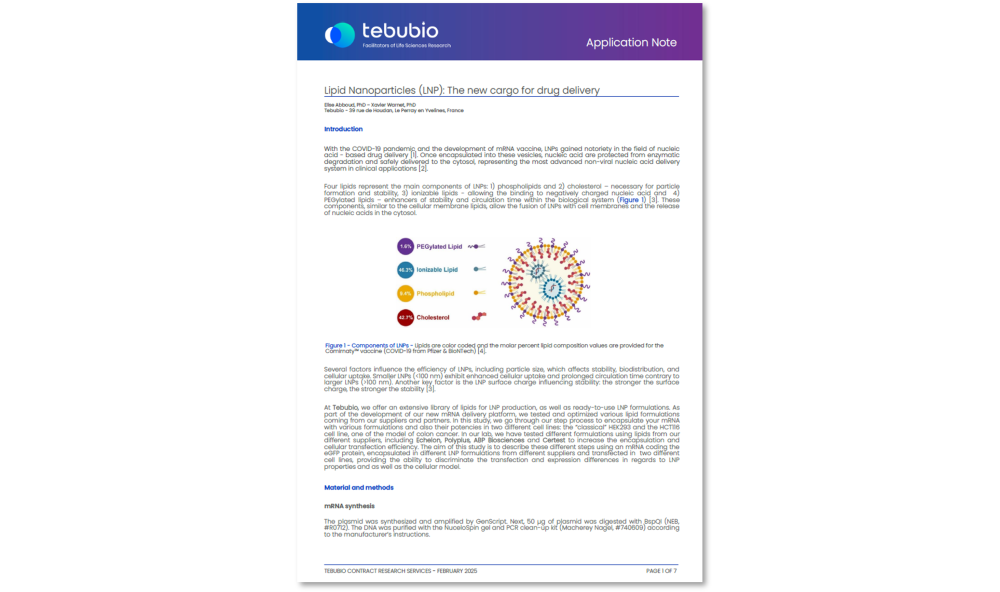
Explore how to optimize Lipid Nanoparticules for mRNA delivery for drug development.
This study highlights key formulation parameters: buffer composition, lipid selection; crucial for enhancing transfection and therapeutic efficacy.

Xavier Warnet PhD, our CRO's project manager published a review on how scientists have developed lipid nanoparticles (LNPs) that make it possible to deliver RNA in a more precise manner, paving the way for future development in oncology.
Why Choose Tebubio as Your Laboratory Service Provider
EXPERTISE
PhD-level expertise
Scientific guidance tailored to your research question.
FLEXIBILITY
Support at the right scale
From a single assay to a complete study, with solutions that evolve with your project.
SIMPLICITY
One partner, less complexity
From study design to results, with a dedicated project manager by your side.
ACCESSIBILITY
European expertise, global reach
Your research, handled in France, with close collaboration and support for researchers in Europe.
 RNA Therapeutics
 Cell Therapy
 Biotherapeutic Discovery
Choose Tebubio as Your Laboratory Service Provider
EXPERTISE
PhD-level expertise
Scientific guidance tailored to your research question.
FLEXIBILITY
Support at the right scale
From a single assay to a complete study, with solutions that evolve with your project.
SIMPLICITY
One partner, less complexity
From study design to results, with a dedicated project manager by your side.
ACCESSIBILITY
European expertise, global reach
Your research, handled in France, with close collaboration and support for researchers in Europe.